


Nduja Cresponcino and Orba of Spilinga
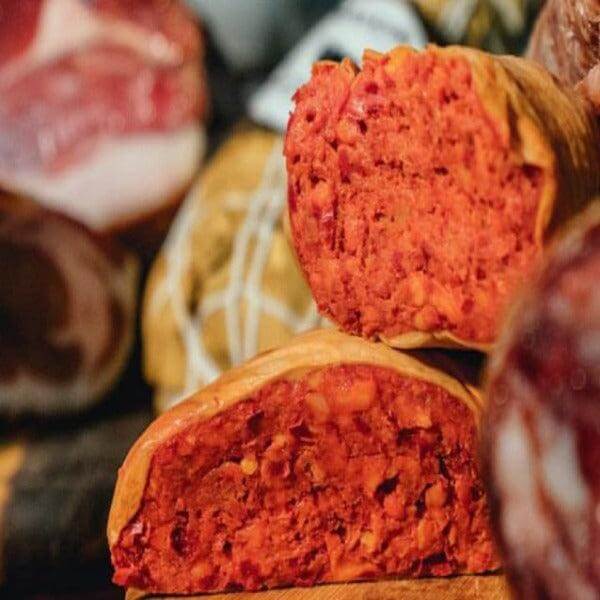
the real nduja of Spilinga in Calabria where tradition and artisans still make the difference. The name nduja derives from "andouille", a French word that defines a type of soft sausage. In the past, the nduja was a poor man's dish: it was prepared with the less noble parts of the pig, but today only the best parts are used and they are mixed with salt and Calabrian chilli pepper, both sweet and spicy, which give flavor to the sausage and its typical red color. The mixture is then inserted into a pork casing: it will then be subjected to light smoking and left to mature for several months. Once ready, the nduja is the queen of Calabrian appetizers, ideal for spreading on croutons and bruschetta and for seasoning pasta. The product has at least 60% meat and the rest is Calabrian chilli grown in-house. The product is distinguished in cresponcini weighing no more than 400 g and orba weighing more than 3 kg. The product is lightly smoked.
suggestion: it is usually spread on bread, to dampen its spiciness, but it is also excellent as a condiment for pasta, with its strong and really tasty flavour. Among the types of pasta to use for this recipe, you can choose between spaghetti, linguine, scialatielli, fusilli, rigatoni, penne, to be seasoned with a sauce made with Tropea onion, tomato pulp and nduja, flavored with a few basil leaves. But here's how to prepare, quickly and easily, this spicy and appetizing first course that will make your taste buds explode with flavor, thanks to its unique and strong flavor. Cut the onion and fry it in a non-stick pan with oil. As soon as it starts to brown add 50 ml of hot water and add the nduja previously freed from the gut and cut into small pieces. Cook by pouring another 50 ml of hot water: stir until the nduja melts. Now add the tomato pulp and cook for fifteen minutes over medium heat, stirring occasionally. Finally add the basil. Cook the pasta in boiling water according to the cooking time indicated on the package. Once ready, drain the pasta and toss it in the pan with the sauce until it takes on flavour. Your pasta with nduja is ready to be served piping hot, perhaps with the addition of grated Parmesan cheese and a sprinkling of pepper.to make your pasta with nduja even more tasty you can add to the sautéed onion also two green chillies cut into rounds. Cook the pasta "al dente" and sauté it in the sauce to add flavor. A tip is to use the whole wheat pasta that retains very well the sauce and enhances the flavor of nduja. If you wish, you can also add bacon or a little chilli pepper to the sauce, if you want to enhance the spiciness. Use a little salt to season the sauce and the pasta because the nduja is already quite salty.
Ingredients and allergens
Ingredients and allergens
🌶️ Ingredienti La ricetta originale di Spilinga è sacra e rigorosa, priva di conservanti, coloranti, nitriti o nitrati. Il colore rosso fuoco è dato esclusivamente dalla quantità impressionante di peperoncino: Grasso e Carne di Suino Selezionati (~70%): Si utilizzano le parti grasse nobili del maiale (sottogola, lardello e pancetta) unite a una piccola percentuale di parti magre (rifilature di spalla e coscia). Peperoncino Rosso Calabrian Essiccato al Sole (~30%): Un mix sapiente di peperoncino dolce (per il colore e l'aromaticità) e peperoncino piccante (per la spinta termica), coltivato esclusivamente sul territorio del Monte Poro. Sale Marino: L'unico conservante naturale ammesso dalla tradizione.
Nutritional values
Nutritional values
📊 Valori Nutrizionali Medi (per 100 g)Trattandosi di un salume a base principalmente di grasso suino e peperoncino, è una bomba di energia, ricca di acidi grassi e capsaicina (l'elemento piccante del peperoncino, noto per le sue proprietà antiossidanti e vasodilatatrici).Elemento Quantità Energia (Calorie)~510 - 540 kcal Energia (Kilojoule)~2150 kJ Grassi Totali~48 - 52 g* di cui acidi grassi saturi~18 g Carboidrati~1,0 g Proteine~15 - 17 g Sale~2,8 g
Origin and production
Origin and production
📍 Origine e Production L'area geografica d'elezione è il comune di Spilinga (Vibo Valentia) e l'altopiano del Monte Poro, dove l'umidità e le brezze marine della Costa degli Dei creano un microclima unico per la maturazione dei salumi. Origine: 100% Calabria (Italia). Il Metodo Tradizionale di Spilinga: La Trafilatura Fine: Le carni e il grasso vengono tritati finemente insieme al peperoncino Calabrian fino a ottenere una pasta omogenea, densa e dal colore rosso uniforme. L'Insacco nel Cresponcino: L'impasto viene insaccato manualmente nel budello naturale crespo e legato saldamente con spago alimentare a formare la classica forma tondeggiante e asimmetrica. L'Affumicatura Lieve: I cresponcini vengono appesi e sottoposti a una delicata affumicatura naturale bruciando legna di ulivo o di quercia. Questo passaggio non serve a dare un sapore "fumè" marcato, ma funge da antisettico naturale e stabilizza il colore. Stagionatura all'Aria del Monte Poro: La ’Nduja matura lentamente per un periodo che va dai 45 ai 90 giorni. In questo periodo i grassi si convertono e si legano al peperoncino, creando la celebre texture che si scioglie al tatto.
Shipping and storage
Shipping and storage
📦 Spedizione e ConservazioneLa Spedizione di Tastiness Food ShopCresponcino Sottovuoto Sigillato: Spediamo il cresponcino intero protetto da un sottovuoto ad alta resistenza. Il sottovuoto evita che la ’Nduja perda i suoi oli essenziali rossi e ne preserva la cremosità d'origine.Logistica Isotermica: Utilizziamo scatole isotermiche con ghiaccio gel refrigerante. Anche se la ’Nduja è molto stabile grazie al peperoncino, la catena del freddo ($+2^\circ\text{C} \mathbin{/} +8^\circ\text{C}$) impedisce che il grasso si surriscaldi e trasudi all'interno della plastica, alterando l'estetica del prodotto.Conservazione e UsoIn Frigorifero: Conservare il cresponcino sigillato nel reparto salumi a circa $+4^\circ\text{C}$. Si conserva intatto fino a 6 mesi.Dopo l'apertura: La ’Nduja non fa la muffa grazie al potere schermante del peperoncino. Una volta tagliato il cresponcino, basta coprire la superficie tagliata con della pellicola alimentare o carta da forno e riporlo in frigo (non è necessario coprirlo d'olio). Consumare entro 2-3 mesi.Come Servirla: Non spalmare mai la ’Nduja fredda di frigorifero! Toglila dal frigo almeno 45 minuti prima del consumo. A temperatura ambiente il grasso torna morbido e spalmabile. L'ideale è scaldarla leggermente nell'apposito Scalda-’Nduja in ceramica con una candelina, oppure spalmarla direttamente sul pane casereccio caldissimo appena brustolito.


Crea il tuo Tagliere Impeccabile


